
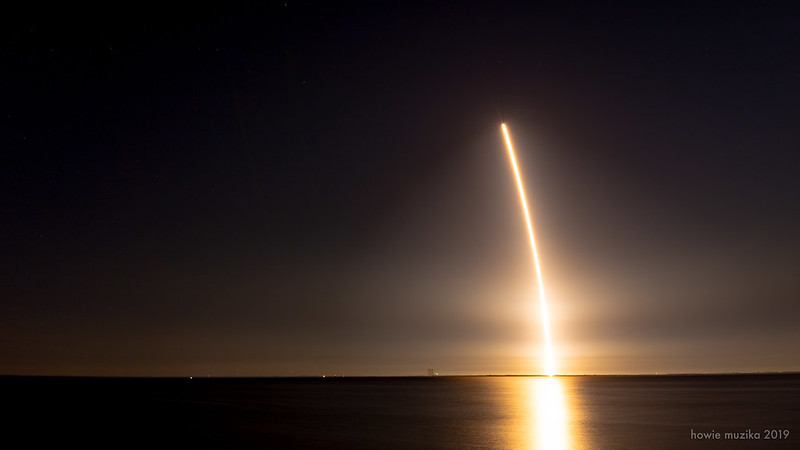
The summer of 2021 has marked a paradigm shift in the aerospace industry. Commercial spaceflights carrying human beings, without the sponsorship of a national space program like NASA, have lifted off for the very first time. On July 11th, Virgin Galactic launched its VSS Unity spaceplane on a suborbital trajectory. The spaceplane, which is carried high into the atmosphere by a mothership airplane before igniting its rocket engine, reached an apogee of 86.182 kilometers. Six people were aboard the vehicle, including the founder of Virgin Galactic, famous wealthy person Richard Branson.
As of this writing, tomorrow, on July 20th, another famous wealthy person who founded their own aerospace company will be taking a trip into suborbital space. Jeff Bezos will be joined on the New Shepard capsule by three other people. The New Shepard capsule will fly a little higher than VSS Unity, reaching above the internationally recognize edge of space at 100km altitude, instead of the 80km altitude that NASA and the US military as the edge of space.
Eclipsing both of these suborbital flights will be the Inspiration4 mission, flown on a SpaceX Crew Dragon capsule. Rather than a suborbital hop, during which the length of time spent in zero-g by a crew member can be measured in minutes, the Inspiration4 mission will spend three days in space, at a projected altitude of 540km, or higher than the average altitude of the International Space Station. This particular Dragon capsule, named Resilience, has also already been to space, sending a crew of four professional astronauts to the International Space Station and back.
The connecting threads that tie these missions together, and the coincidence that they will be lifting off in the same calendar year, is remarkable. Each features at least partial reusability of the vehicles, a development seen previously only on the NASA Space Shuttle. The Virgin Galactic spaceplane and mothership both return to terra firma on a runway, like an ordinary airplane. The Blue Origin booster stage returns to the ground propulsively while the capsule lands with a combination of parachutes and retro-rockets. The first stage of the SpaceX Falcon 9 rocket also lands propulsively, while the Resilience capsule already another commercial spaceflight planned after the Inspiration4 mission. In years past true, affordable reusability of rockets was a fantasy. The Space Shuttle orbiters and their solid rocket boosters were reusable, but only after expensive maintenance. True reusability, where a vehicle can be returned to flight-readiness cheaper or quicker than building a new one, was achieved by the private sector, not by a government sponsored program.
Which is not to say that Elon Musk, Richard Branson, or Jeff Bezos have not had support from the public in the form of subsidies to build their facilities or government contracts to use utilize their vehicle in support of missions and scientific payloads. They have received help, to varying degrees. And they didn’t develop their rockets on their own. Each have companies filled with engineers and scientists educated in public universities, and often with previous experience at NASA or the older, traditional aerospace contractors.
The fact that the achievements of Blue Origin, SpaceX, and Virgin Galactic are possible is both a sign of technological progress in spaceflight, and a signal of how much wealth income inequality can allow individuals to amass. At the same time it is both good that the barrier to real advancement in space has lowered enough that non-state commercial entities can take on the challenge, and bad that modern capitalism means that individual human beings can bankroll a space program while other human beings struggle to pay their bills on time.
The wildly varied coverage of these achievements have shown this paradox. Branson, Bezos, and Musk are evil billionaires who would waste billions on useless rockets rather than spend money fixing problems back here on Earth for everyday people. Or their rockets are just another thing helping to exacerbate climate change, with their nasty fossil-fuel based exhaust fumes. The companies they run might not always be acting in the best interest of the public in everything that they do. Or they might act crazy on twitter sometimes. Oh, but there rockets are pretty cool, I guess, if you are into that sort of thing.
There is a lot of truth in that previous paragraph. Elon Musk’s Tesla has been enormously important in developing and advancing electric vehicles and renewable energy, both industries that are hugely important in dealing with climate change. But his companies have also been hostile to labor unions, local government oversight, and had its fair share of ethical workplace concerns. Amazon is a paragon of modern American capitalism, joining other tech companies like Apple, Google, and Facebook that collectively have established the United States as a firm 21st century leader. But Amazon’s labor practices also suck, and in general its effect on multiple industries has been like that of a wrecking ball.
Which is to say that public opinion on both Bezos and Musk is highly polarized, like so many other aspects of modern life. Branson, and his Virgin Group conglomerate, is less well-known compared to the other two, but in general most people by default don’t spare a lot of emotional labor on a billionaire. After the disastrous presidency of self-reported billionaire Donald Trump, who can blame them.
Still, it’s not a good idea to let our personal feelings towards individuals cloud our judgment. The ongoing and escalating achievements of these commercial spaceflight could revolutionize human civilization. That might sound hyperbolic, but what would someone who witnessed the rise of steam-powered ocean liners have told you after civilization’s previous fastest way to cross an ocean was catching the wind in a giant cloth sheet? What would someone have told you about impact of the automobile after they previously had to make a day-trip just to get to the next town down the road? Or the impact of the telephone as compared to the written letter? Real, permanent, affordable spaceflight has the potential to change life on earth just as much as those previous technological advancements.
And as a multitude of writers all parroting the same hand-wringing hot takes as each other will tell you, we are in dire need of some impactful technological advancement. Climate change is real, and it is currently devastating the planet. It’s only going to get worse. Efforts to adapt to climate, or even to reverse its effects, are currently inadequate. Seriously working to fix the damage that the last couple hundred years of industrialization have wrought on the planet requires big investments and deployments of new technologies. It requires changes across industries, including agriculture, transportation, manufacturing, construction, and more. We have to do a better job preserving the natural resources we still have, and restoring the ones that have already been damage. It also requires the political will to make those changes, something that technology alone can’t do.
A favorite trope I’ve noticed across criticisms of Branson, Bezos, and Musk is comparing the pollution caused by their rockets to that of the airline industry. It’s an easy comparison to make, not the least because many ordinary people have travelled on an airline flight and can contextualize it. A recent article in the Futurism publication stated:
“For one long-haul plane flight it’s one to three tons of carbon dioxide [per passenger],” Eloise Maraise, an associate professor of physical geography at University College London, told the Guardian. One rocket launch, in contrast, produces about 200-300 tons for a flight of around four passengers.”
Yes. A single rocket launch is way more polluting than a single flight on an airliner.
But then:
“Fortunately, rocket launches are still pretty low on the polluter list on a global scale. While 100,000 planes take off on an average day, only 114 rockets attempted to orbit last year, according to NASA.”
The entire rocket launch industry, suborbital and orbital, is not pretty low on the polluter list. It’s near the bottom of the list. Examining this logic pretzel and taking their numbers at face value (100,000 flights a day at 1-3 tons per flight, vs 114 rockets a year at 200-300 tons) will quickly show how preposterous this comparison is. 100,000 flights a day multiplied by 2 tons (the average of the number given) gives us 200,000 tons a day. Multiplied by each day in the year that give us 73 MILLION tons a year. For rockets the math is 114 multiplied by 300 tons (I’ll assume that larger rockets represent the most pollution and take the higher end of the estimate), for a total of 34,200 tons. Again, that’s 34,200 tons versus 73,000,000 tons. In other words, the airline industry puts into the atmosphere every four hours, every single day, the same amount of pollution that the entire global spaceflight industry does in an entire year. Yes, every bit of new greenhouse gasses put into the air is bad. But when your ship is sinking you worry about the giant hole through which water is gushing first, rather than the raindrops hitting you on the head.
It is also worthwhile to point out that the science and technologies needed to combat climate change are often advanced through spaceflight applications. An entire separate essay could be written on all of the spin-off technologies first advanced because of their applications in space, but in general renewable energy, materials science, highly efficient resource recycling and reuse, sustainable agriculture, and advanced robotics are need just as much in space as they are back here on Earth. The development and advancement of science and technology may seem like a slow process, where it can be hard to pinpoint quick returns-on-investment with every single rocket that goes up, but the advances over time builds on itself. A little over twenty years ago only a few households in the country had access to the internet. Now most people walk around with a comparative super computer tucked into their pocket.
To me it seems like we are talking out of both sides of our mouths when trying to encourage schoolchildren to get enthusiastic about science, technology, engineering and math while also deriding the most inspiring achievements people in those fields can accomplish. Yeah kid, study science and engineering. But if you use that to do anything involving rockets you’ll be ridiculed.
The preceding paragraph involves an oversimplification. But in a country that has a hard time getting a size-able proportion of the public to accept the science behind climate change, or the science behind vaccines, maybe writers should spend less time copy and pasting the same bad arguments over and over again. Don’t use your platform spreading stupidity. You aren’t cool, or edgy, or smarter than anyone else just because you’re a cynic.
For sure we need to do more to combat climate change. But there are any a huge number of industries, with a much bigger impact on the climate, that we need to work at changing first. Agriculture is one. The meat section at your local grocery store represents more pollution than rockets do. The automobile you drove to get the grocery represents more pollution than rockets do. The warehouse sized servers that all of your the videos, posts, and profiles live on across social represents more pollution than rockets do (yes, also the server that this blog post lives on). The clothes you are wearing represent more pollution than the rockets do.
The problems we have down here on Earth will not suddenly be solved if not a single additional rocket is ever launched, or a single additional dollar is spent sending something into orbit. You can invest in cleaning up the environment while supporting spaceflight. You can adapt strategies to reduce income inequality, everything from a universal basic income, to a wealth tax, to increasing the minimum wage, to subsidizing affordable housing. You can reduce the costs of healthcare and education, and expand access to them for all people. We should do those things. We should also continue supporting spaceflight. It may currently be limited to those of means, but it used to be limited to world superpowers, and one day may be accessible to all. The total amount of money spent on space is a minuscule percentage of the United State’s annual budget. If the money spent on rockets is your issue, there are plenty of bigger problems to tackle first, just as in the pollution analogy.
You don’t have to like Bezos, Branson, Musk as individuals. But deriding the achievements of their companies, and all of the hard working people who make those achievements possible, because of them is not helpful. Parroting bad arguments without any of your own unique contributions is not helpful. Bernie Sanders was right that we don’t need to be giving Jeff Bezos money when he’s got more of it than he seems to be able to spend. But he, and others, are wrong if they think the contributions to society due to the work Blue Origin and other companies like them are doing don’t matter.
 ThisFicWriter